trying to make it work
Sometimes the hardest part of a project isn’t the idea. It’s figuring out how to make the idea exist in the real world.
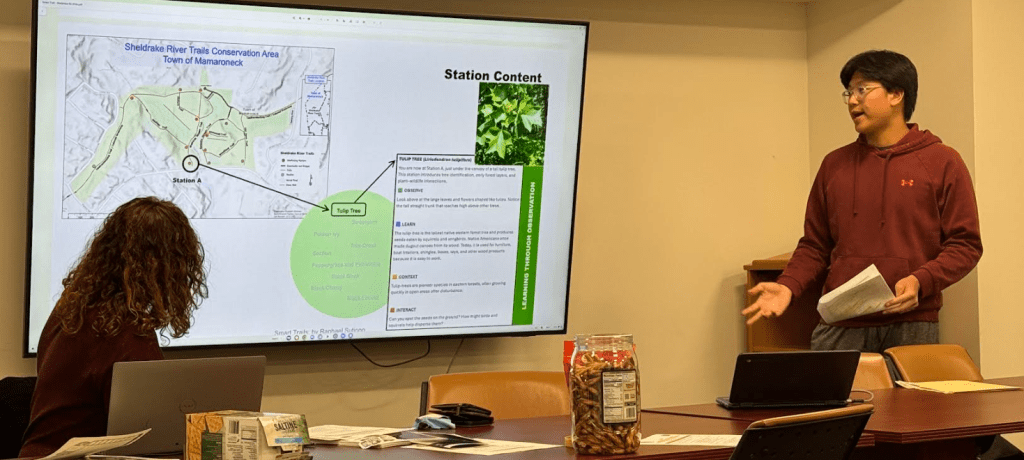
Over the past few months, I’ve been continuing to work on the digital Walkbook project for the Sheldrake trails. At first, most of the work felt straightforward: typing and reorganizing the original paper Walkbook, scanning drawings, structuring each station into consistent sections, giving presentation pitches, and thinking about how the trail experience could become more interactive through QR codes and a clickable digital map.
I loved that part. It felt creative, yet also strangely technical. I started organizing trail stops as structured data, researching different mapping tools, thinking about user experience, and trying to imagine what it would actually feel like for someone to walk through the trails with a phone in hand, scanning stations and learning about the environment around them in real time.
In my head, the ideal version became very vivid:
an interactive trail map, dynamic QR codes, clickable stations, engagement data, something modern and educational but still connected to the quietness of the woods.
But lately, I’ve learned that building something like this doesn’t just involve the project itself. It involves systems. Websites. Hosting. Permissions. Coordination. Questions nobody initially thinks about.
Who owns the map?
Where does the content live?
Who maintains it?
What platform supports it?
What happens if something breaks?
And suddenly the project became less about simply making something and more about navigating all the invisible layers underneath it.
At first, I think I underestimated how complicated implementation could become. Not because anyone was against the idea – actually, people have been supportive – but because when a project overlaps between organizations, websites, departments, and technical systems, things naturally move slower and become more complicated.
I’ve realized that sometimes there isn’t already a clear path forward. You kind of have to build the path yourself.
So recently, I’ve been thinking more independently about what this project could realistically become – maybe hosting it myself, publishing it separately, embedding maps through outside tools, or even using this blog as part of the platform. The project has started evolving from “digitizing a trail guide” into learning how digital infrastructure, environmental education, and public access actually intersect.
And honestly, even though it’s frustrating at times, I think it’s been one of the most valuable learning experiences I’ve had. Because sustainability work isn’t always clean or immediate. A lot of it lives in the awkward middle space between idea and implementation.
a club that actually grew
At the same time, Project Green this year has been growing in ways I honestly didn’t expect.
At the end of this year, I became one of the three co-presidents of the club, and looking back, I think the biggest accomplishment has simply been growth. At the beginning of the year, our meetings were much smaller. Now, the club has grown to around three times the size it was before, with more people showing up regularly and actually wanting to participate.
That’s been really rewarding to see.
We’ve continued our compostable cups initiative throughout the school, but we’ve also started moving into energy conservation work. Earlier this year, after conversations with facilities and our school’s energy conservation partner, Cenergistic, I helped start a new initiative focused on measuring idle energy use around the building.
Basically, we’ve been using plug monitors to track how much electricity devices – especially classroom smartboards – consume even when nobody is using them. It sounds small, but I think projects like this matter because they make energy visible. Most people never think about electricity when nothing is happening. But schools are full of systems quietly running in the background all the time.
I’ve noticed that a lot of the projects I’m drawn toward lately involve making invisible systems more visible – whether that’s energy use, flood infrastructure, trail education, or local ecosystems.
climate through community
Recently, the Youth Steering Committee for the Climate & Resilience Education Task Force also wrapped up for the year, which honestly feels strange after months of weekly meetings and conversations.
One thing that really interested me recently was hearing about the ACES project during our final session of the year – Advancing Climate Education in Schools – a student-led initiative where high school students lead hands-on climate workshops for younger students.
I immediately loved the idea.
Partly because it feels practical and direct, but also because it focuses on something I’ve been thinking about more and more lately: impact. The abstract ideas in addition to tangible educational experiences that actually reach kids.
I think that’s part of why the Walkbook project has mattered so much to me too. I want to create things that people can interact with – things that help them notice their environment differently.
And maybe that’s also why it’s been difficult watching parts of the project stall while figuring out logistics and systems. But I’m slowly learning that progress doesn’t always look like completion. Sometimes progress is learning how complicated real implementation actually is. Sometimes it’s realizing that meaningful work often takes longer than you imagined.
It’s honestly crazy that junior year is already starting to come to a close. It’s definitely been the most stressful year of high school so far, but also one of the most meaningful. Even when projects move slowly or things feel overwhelming, I’m grateful for everything I’ve learned, the people I’ve met, and the ways I’ve grown through it all.


Leave a Reply