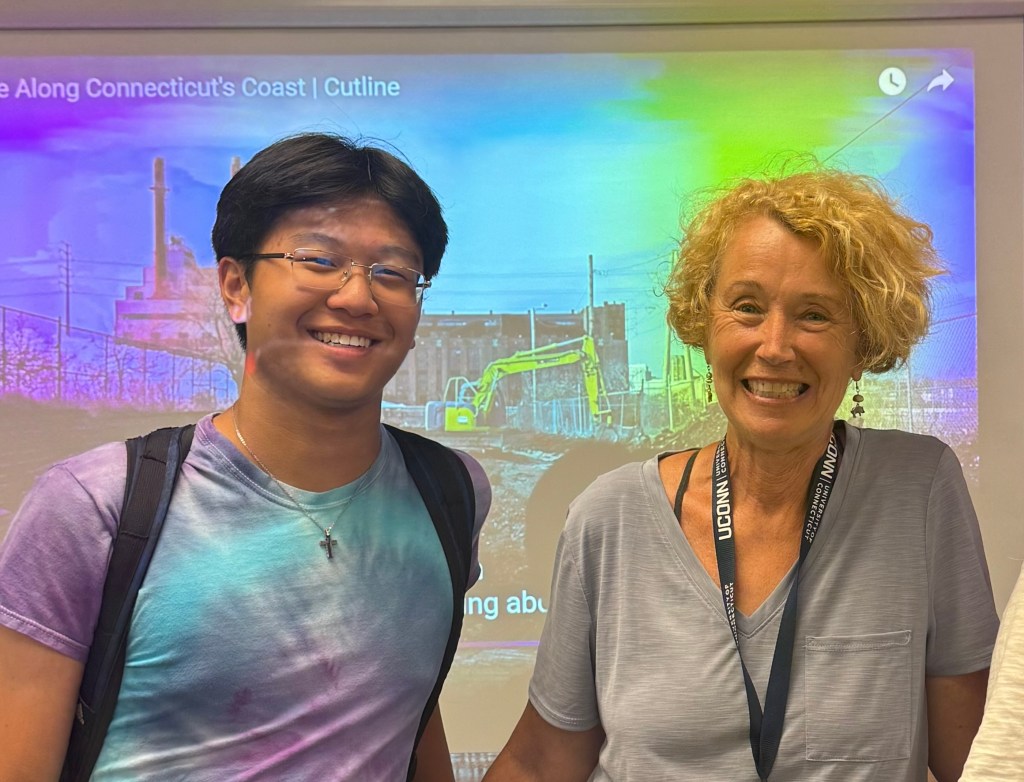
As I mentioned in previous posts, I took Columbia Precollege Program’s Environmental Studies: Designing a Sustainable Future course this summer – a three-week deep dive that completely shifted my mindset.
Our classroom wasn’t dark – but it was old. High ceilings, old, wooden lecture-style chairs, chalkboard walls. And the AC? Blasting like we were trying to refrigerate the entire building. It was freezing in there. Every single day. Our professor, Nicola Barratt, would mention how unsustainable it was – wasting electricity just to make students shiver in July. That kind of thing stuck with me. It wasn’t just a throwaway comment. It was a glimpse into how deeply she believed in practicing what she preached. Even though she lived in America, where air conditioning is just part of everyday life, she chose not to install one in her home – fully aware of the negative environmental impact. That kind of commitment showed me how deeply passionate she was about the cause. From the very first day she shared this with us, I knew I was in for a ride for the next three weeks.
Each week of the course focused on a different theme: energy, food & water, and biodiversity. But it never felt like a traditional science class – it felt like a reality check. We started with the basics – how our energy systems work and how broken they are. I had never really thought about how inefficient fossil fuels are until we mapped out how much heat just… disappears into the air. We dove into renewables: solar panels, wind turbines, hydro, geothermal. We learned the pros and cons, the infrastructure challenges, and the science behind how they work. Nuclear fusion came up too – super cool in theory, but still stuck in the future. We learned that using hydrogen fusion for energy means turning hydrogen into plasma by heating it to millions of degrees and using powerful magnets to hold it in place. This process needs extremely high temperatures and pressure, and though promising, it’s still very expensive and not practical yet. Scientists think it could be feasible in the next few decades if technology improves and international cooperation increases.
Food and water systems were next. I used to think organic just meant “better,” but the truth is way more complicated. Industrial farming, monocultures, irrigation, fertilizer runoff – we broke it all down. We talked about water insecurity, not just globally but even in places like the U.S. where you’d assume it’s not an issue. (Spoiler: it is.)
And then biodiversity – probably my favorite topic. We learned about keystone species, ecosystem services, coral bleaching, invasive species, deforestation. It hit me how interconnected everything is. Take one thing out of balance, and the whole system shifts. Sometimes forever.
We had incredible guest speakers too, like Mr. Ntiokam Divine, one of the founders of the Climate Smart Agriculture Youth Network based in Cameroon. He came in person – he was in town for a NATO conference – and spoke to us about his non-profit and gave us some very impactful advice. What really stuck with me was his life advice: passion is what takes you to the next level. He explained the difference between skills and talents – workers develop skills, but leaders combine skills with talent and passion. Another powerful takeaway was the idea of “idle at Yes” – the default answer to new opportunities should be yes. Say yes, say yes, say yes.
His story made his words even more impactful. Coming from an incredibly poor single-parent household, Mr. Divine grew up passionate about the environment despite never having formal education in environmental studies. He followed that passion and eventually founded a non-profit that has now expanded globally. Despite the lack of traditional schooling, he’s built genuine connections with people worldwide and achieved remarkable success. Along the way, he faced friends who abandoned him, doubting his vision and potential. His advice? “Run away” from those types of people – they’ll never help you get far. I found his story incredibly inspiring and a true testament to the power of passion and resilience.
His passion and optimism were contagious, and the advice felt genuinely applicable – not just for careers in environmental work, but for life in general.
Throughout the duration of the course, Professor Barratt assigned us to read Hope Dies Last by Alan Weisman. It’s a powerful book about the challenges and possibilities of building a sustainable future. From pages 31 to 43, Weisman lays out four “miracles” we need:
- Preserve Biodiversity: protecting the variety of life on Earth keeps our planet healthy and balanced.
- A New Green Revolution: combining old farming wisdom with new technology to grow more food on the same land, like how India quadrupled its rice output.
- Controlling Overpopulation: stabilizing population by lowering birth rates to about 2.1 children per woman through education and healthcare improvements.
- Energy for All: ensuring everyone has access to clean, reliable energy for electricity, transportation, and heating, which is vital to reduce poverty and fight climate change.
The book also introduced me to fascinating innovations like nitrogen fixation by microbes, which plants rely on to get nitrogen from the air; growing food from air and electricity using microbes – no soil or sunlight required; and the surprising fact that plastics and food are made of the same basic elements (carbon, hydrogen, oxygen), just arranged differently. These microbial foods could help solve hunger and reduce pollution by cutting the need for traditional farming.
Reading Hope Dies Last didn’t just inform me – it inspired me. It showed that solutions come from science, technology, and everyday people making thoughtful choices.

This course wasn’t designed to scare us. It was meant to empower us. Professor Barratt taught with so much heart and urgency, and every discussion felt like it mattered. We weren’t just learning about sustainability – we were learning to think sustainably, ask better questions, and connect daily choices to global systems.
Reflecting on the experience, I realize it’s not all about the content and information you learn, but the relationships you build – especially with the friends I made in the class, who came from all over the world and country. The general life advice given by Professor Barratt and guest speakers like Mr. Divine was just as valuable as the academic lessons. Professor Barratt is a connection I won’t ever forget and may be a great mentor and source of knowledge in the future. It surprised me how knowledgeable one person can be – she has lived all around the world, including Africa, and shared so many insightful stories from places like Madagascar, always connecting them back to what we were learning in class.
If you’re a highschooler even remotely interested in the environment, I’d recommend this course in a heartbeat. And definitely the book. Stay curious. Because the truth is, we’re all part of this. Whether we decide to look away or step in – that’s up to us.
And yeah – hope does die last. But as long as it’s alive, there’s work to do.
 Unwrapped Earth
Leave a comment